
Carpet to Hardwood Stairs: What the Conversion Involves
From tearing off carpet to staining treads that match the floor below — the full staircase conversion, step by step.
- 5.0★ from 65 Google reviews
- 20+ years in East Idaho
- Free written estimates
- Dust-contained sanding
- Moisture tested before install
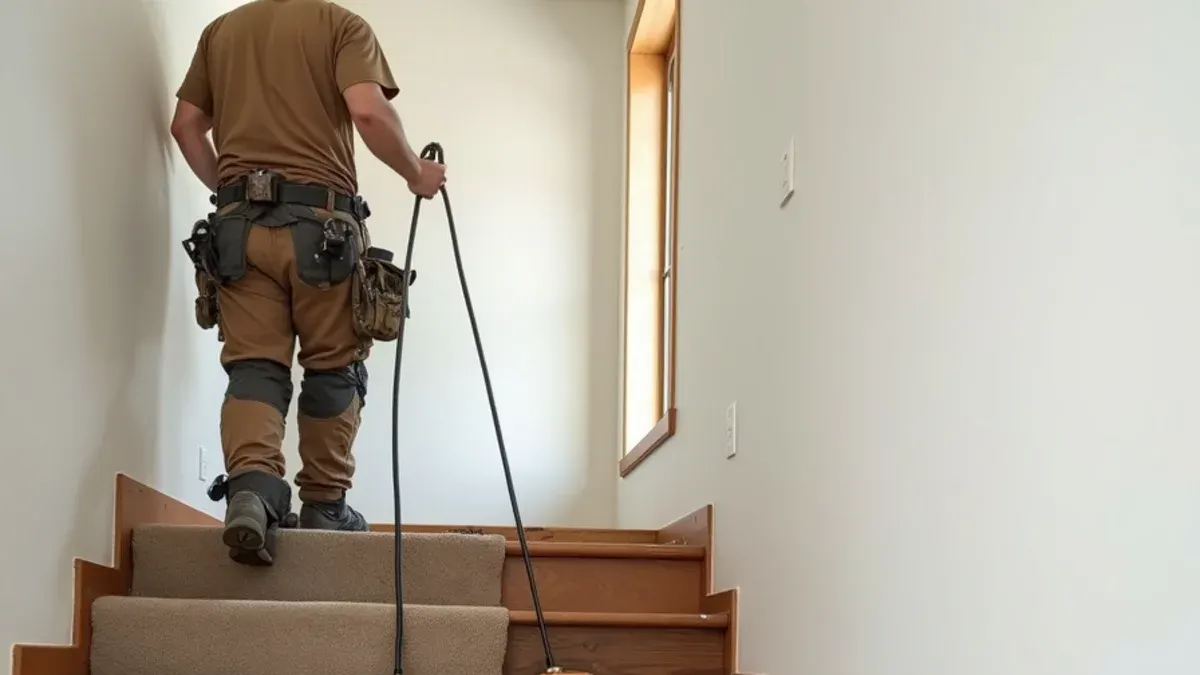
Converting carpeted stairs to hardwood means stripping the carpet, checking the rough stringers underneath, then capping each step with a finished tread, a riser and a bullnose nosing. Most staircases here were framed carpet-grade, so you're rebuilding the visible surface, not just refinishing bare wood.
What's actually under your carpeted stairs?
Pull the carpet off a staircase in Ammon or Chubbuck and you rarely find a finished floor waiting. Builders framed carpet-grade stairs to be covered. The treads are usually construction-grade pine or plywood, the front edge is square with no overhang, and the risers may be unfinished or skipped entirely.
That changes the whole job. A hardwood floor just needs sanding and finish. A carpeted staircase needs new finished surfaces built over the existing frame. We start by removing the carpet, padding, tack strips and every staple, then we check the stringers and existing treads for squeaks, rot and level before anything new goes down.
You'll also want to think about the look you're after before work starts. Open-sided staircases, where one or both ends of the treads are exposed, need finished returns on those edges, which adds hand-work. Closed staircases boxed in by walls on both sides are simpler, since only the tread face and the riser show. A landing or a winder, where the stairs turn, is more cutting again.
The good news is that the structure under the carpet is almost always sound. What you're paying for is finish carpentry and stain work, not a tear-out to the framing. That's also why the price is driven by step count and detail rather than square footage; a straight 13-step run costs less than a shorter staircase that turns twice.
Want a straight answer for your floor?
Free, written estimates across East Idaho.
The conversion, step by step
- Strip the carpet, padding, tack strips and staples, then vacuum the stringers clean.
- Inspect each step for squeaks, movement and level; screw down and shim anything loose.
- Measure every tread and riser individually, since older stairs are rarely identical top to bottom.
- Cut and dry-fit solid treads with a bullnose nosing, plus riser boards to close each face.
- Glue and fasten risers first, then treads, setting fasteners below the surface and filling them.
- Sand the new wood, apply stain to match your floor, then build finish coats with cure time between.
Treads, risers and nosing: the three parts that matter
A finished step has three visible parts, and each does a job. The tread is the surface you walk on and takes all the wear, so it's milled from solid hardwood, usually a full inch thick. The riser is the vertical face between steps; it carries no weight but it sets the clean, painted-or-stained look.
The nosing is the rounded front lip that overhangs the riser below. It's not decoration. The overhang gives your foot a safe edge to catch and protects the front grain of the tread from chipping. Skip a proper nosing and the stairs feel wrong underfoot and wear out at the front edge first.
- Treads: solid hardwood, sized per step, the wear surface.
- Risers: the vertical faces, often painted white against stained treads.
- Nosing: the bullnose overhang that makes each step safe and finished.
- Returns: the finished side edges on open, exposed staircases.
How do you match stair treads to the floor below?
Most homeowners want the staircase to read as one piece with the hardwood on the landing. That means matching species, grain and color. If your main floor is red oak, we use red oak treads so the grain pattern lines up. A hickory floor gets hickory treads, and so on.
Color is the harder part. Stain takes differently on new tread stock than on a floor that's aged and seen sunlight for years. We sample stain on offcuts of the actual tread wood, set them next to your floor in daylight, and adjust until the match holds. In many East Idaho homes the existing floor has ambered with age, so the new treads get a slightly warmer tone to meet it.
There's also a sheen to match, not just a color. If your floor is satin, glossy treads will stand out even in the right stain, so we match the finish luster as well. And the wood you can buy today isn't always a perfect twin for a 1960s floor, so sometimes the honest move is to accept a very close match rather than chase a perfect one that doesn't exist.
If your floor and stairs are being done together, matching is simple because everything gets the same stain and finish at the same time. That's the cleanest result, and it's worth timing the staircase with a floor refinish if you're planning one anyway. Call (844) 954-6342 if you want the staircase done as part of a larger floor project.
Retread, cap or full rebuild: the honest trade-offs
There's more than one way to do this, and the cheapest route isn't always the right one. A full solid-tread retread, where we remove the old treads and install new solid hardwood, looks and lasts the best but costs the most in labor. Retro-fit tread caps, which are thinner pieces laid over the existing treads, cost less and move faster but add height to each step and can feel hollow if the base isn't solid.
The honest trade-off: caps make sense on a sound, flat staircase where budget matters. Solid retreads make sense when the existing treads are damaged, uneven or squeaky, or when you want the staircase to last as long as the floor. A full rebuild, replacing stringers and all, is rare and only needed when the framing itself has failed.
One more honest point: skirt boards, the trim that runs up the wall alongside the steps, and any railing or balusters affect the job. If the carpet was tucked behind a skirt board, removing it cleanly and getting the new treads to die into it neatly is fussy work. Painted risers hide a lot; stained risers show every seam, so they demand tighter carpentry.
We'll tell you which one your staircase actually needs after we see what's under the carpet. Stairs are slow, exacting hand-work no matter the method, so an honest scope up front saves surprises later. A staircase done right becomes the first thing people notice walking in, which is exactly why it's worth not cutting corners on the method.
Budget-wise, it helps to think of a staircase as priced per step and per detail rather than as a flat room rate. Each tread is measured, cut, fit and finished on its own, and features like open returns, a landing, winders or stained risers each add hand-work. That's why two staircases with the same step count can quote differently. When we walk your stairs, we count what's actually there and price the real scope, so the number you get reflects your staircase, not a generic average.
FAQ
Quick questions
Can any carpeted staircase be converted to hardwood?
Almost always, yes. The framing under carpet is usually sound; what's missing is the finished surface. As long as the stringers are solid and the stairs aren't rotted or badly out of level, we can cap or retread them in hardwood. We check the structure first and tell you what we find before quoting the work.
Should the treads and risers be the same color?
That's your call. The common look in East Idaho homes is stained treads matched to the floor with painted white risers, which gives a crisp contrast and hides scuffs on the vertical faces. Some owners prefer everything stained the same tone for a seamless run. Both are correct; we sample options before committing.
How long does a staircase conversion take?
A typical straight staircase takes several days, not hours. Carpet removal and prep is day one, installing treads and risers follows, then staining and finish coats each need drying time between them. Stairs can't be rushed because every coat has to cure before the next, and you'll need to limit traffic while the finish hardens.
Are hardwood stairs slippery compared to carpet?
They're harder than carpet, so they need respect, especially in socks. A satin or matte finish gives more grip than a high gloss, and a proper bullnose nosing gives your foot a defined edge. For homes with young kids or older adults, a runner down the center is a common addition that keeps the wood look with added traction.
The bottom line
A carpet-to-hardwood staircase is finish carpentry, not a quick refinish, and it rewards careful work with treads that match your floor and steps that feel right underfoot. If you're in Ammon, Chubbuck or anywhere in East Idaho and want to see what's under your carpet, call (844) 954-6342 and we'll take a look and put a written price in your hands.
Related
Floors on your mind?
Call for a free, written estimate across Idaho Falls and East Idaho.
- 5.0★ from 65 Google reviews
- 20+ years in East Idaho
- Free written estimates
- Dust-contained sanding
- Moisture tested before install
Wood Flooring Idaho · Idaho Falls, ID 83401 · (844) 954-6342